Three Titles We Actually Like
- Your Model Did Not Crash. It Lied.
- Notebook Heroics vs Production Discipline
- The Day-2 Problem of Machine Learning
The Silent Failure Pattern Nobody Warns You About
Traditional DevOps failures are usually loud. A service fails to start. A migration crashes. A health check turns red. You get an exception, a stack trace, and a clear blast radius.
ML systems fail differently. The container runs. The endpoint responds. Latency is stable. But decision quality degrades over days, then weeks, until the business asks why conversion dropped, fraud misses increased, or pricing confidence evaporated.
This is why it worked in my Jupyter notebook is the ML version of it worked on my machine. A notebook proves one thing: a model can fit one historical snapshot under one local runtime. It does not prove your features, labels, contracts, or semantics survive production change.
Software failures are blown fuses. ML failures are miscalibrated instruments. The system keeps running while your decisions get less truthful.
The Core Pillars of MLOps (Without Marketing Noise)
1) Data and Feature Versioning
Git is mandatory, but Git alone is not enough. ML artifacts depend on mutable state outside source code: data slices, feature extraction logic, label windows, and encoder vocabularies.
A useful rule: if you cannot reconstruct exactly code + data + feature spec + config for model v73, you do not have reproducibility. You have luck.
Version control for ML should answer:
- Which exact dataset window trained this model?
- Which feature transformations and joins were applied?
- Which preprocessing artifact was used in online inference?
- Which threshold and post-processing policy was active?
2) CI/CD/CT Instead of CI/CD Only
In regular software pipelines, deploys are driven by code commits. In production ML, quality can degrade with zero code changes. That is why mature teams add CT (Continuous Training).
CT is not retrain-on-cron by default. That causes expensive noise. CT should be policy-driven and tied to observed risk.
ct_policies:
  schema_contract:
    action_on_break: fail_pipeline
  drift:
    psi_warn: 0.15
    psi_retrain: 0.25
    js_retrain: 0.10
  quality_guardrails:
    min_auc: 0.84
    max_ece: 0.06
    label_lag_days: 3
  retrain_limits:
    min_new_samples: 100000
    cooldown_hours: 24
    max_retrains_per_week: 3
3) Model Observability and Drift
Most teams say drift as if it is one metric. It is at least two different failure classes:
- Data Drift: input distributions move over time.
- Concept Drift: the relationship between input and label changes even if input distributions look stable.
Data drift can be harmless if the model generalizes. Concept drift can be fatal even when feature histograms look healthy. That is why observability needs three layers: feature behavior, prediction behavior, and delayed outcome behavior.
from dataclasses import dataclass
import numpy as np
from scipy.spatial.distance import jensenshannon

@dataclass
class DriftResult:
    feature: str
    js_divergence: float
    status: str

def js_drift(train_hist, serving_hist, eps=1e-12):
    p = np.array(train_hist, dtype=float) + eps
    q = np.array(serving_hist, dtype=float) + eps
    p /= p.sum()
    q /= q.sum()
    return float(jensenshannon(p, q))

def evaluate_feature(feature_name, train_hist, serving_hist, threshold=0.10):
    d = js_drift(train_hist, serving_hist)
    return DriftResult(feature_name, d, "retrain-candidate" if d >= threshold else "stable")
Architectural Blueprint: End-to-End MLOps Flow
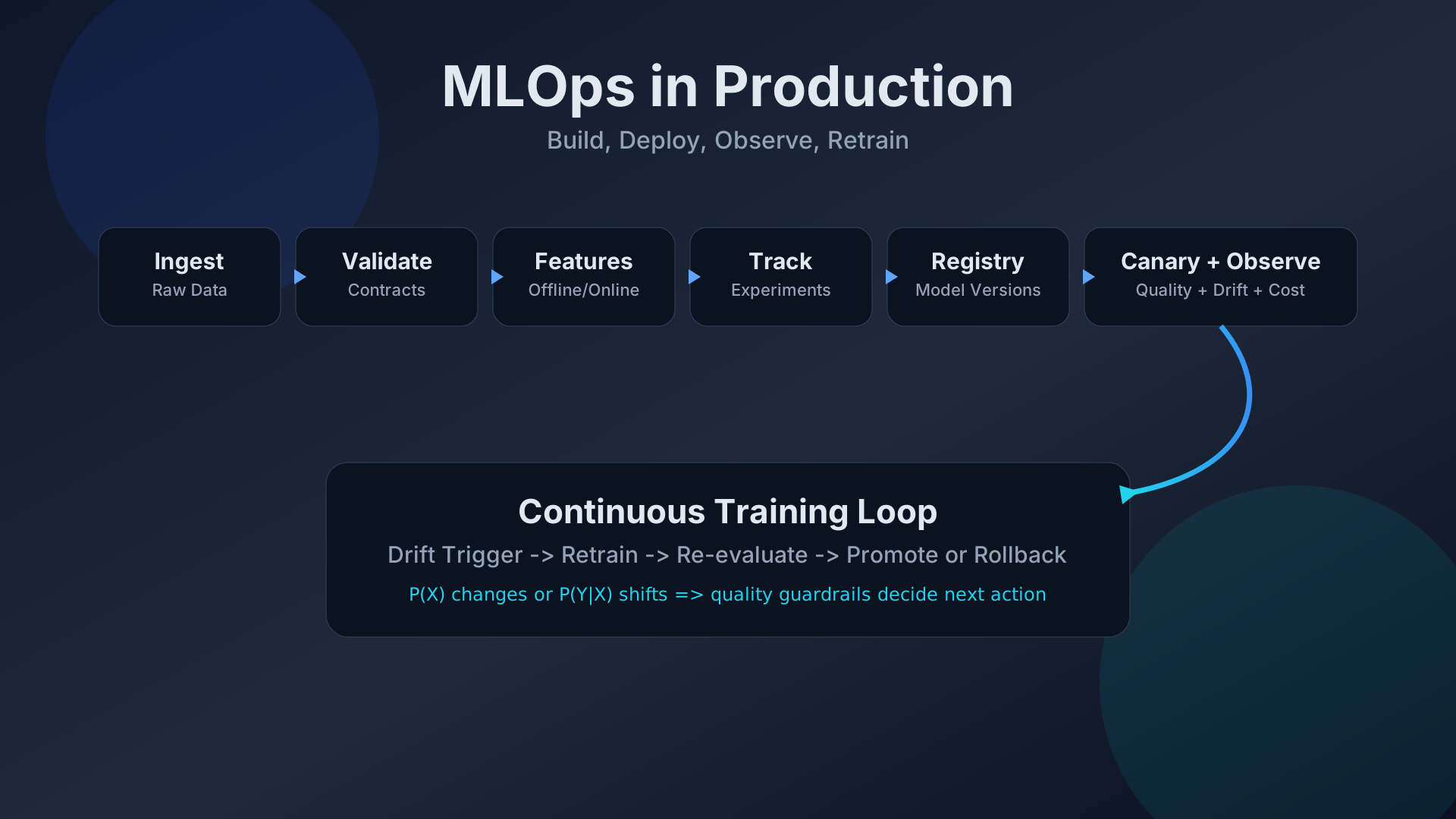
A production ML platform is mostly a state-management problem with strict control points. Here is the practical sequence we implement for enterprise teams:
Raw Ingestion
   -> Validation (schema + semantic contracts)
   -> Feature Pipeline
   -> Experiment Tracking (runs, params, artifacts)
   -> Model Registry (staging -> production)
   -> Canary or Shadow Deployment
   -> Runtime Monitoring (infra + drift + business KPIs)
   -> CT Trigger Engine
   -> Retrain / Re-evaluate / Promote or Rollback
Step-by-Step Control Gates
Data Ingestion and Validation: separate structural checks from semantic checks. Type safety catches obvious errors; semantic contracts catch expensive ones like unit mismatch and hidden null defaults.
Experiment Tracking: log failed runs and mediocre runs, not just best runs. Incidents are diagnosed through comparison, not memory.
Registry Promotion: every promotion must carry a manifest that links model binary, data reference, feature hash, and threshold policy.
Canary and Shadow: canary routes a small percentage of live traffic. shadow receives mirrored traffic without decision impact. both are useful, but for different risk profiles.
def promote_model(candidate_metrics, baseline_metrics):
    if candidate_metrics["p95_latency_ms"] > 120:
        return "reject: latency regression"
    if candidate_metrics["auc"] < baseline_metrics["auc"] - 0.01:
        return "reject: quality regression"
    if candidate_metrics["ece"] > 0.06:
        return "reject: calibration risk"
    if candidate_metrics["max_feature_js"] > 0.12:
        return "hold: distribution instability"
    if candidate_metrics["fp_cost_delta"] > 0.03:
        return "reject: business cost regression"
    return "promote"
Common MLOps Anti-Patterns (And Why They Hurt)
Anti-Pattern 1: Treating Models as Static Files
"We shipped model.pkl" is not a release strategy. A model binary without feature lineage, data snapshot reference, and threshold policy is only half an artifact.
During incident response, teams must answer in minutes:
- What changed between versions?
- Was it code, data, features, or threshold policy?
- Can we roll back both model and feature contract safely?
Anti-Pattern 2: Heavy Preprocessing Inside the Endpoint
Many teams put expensive data cleaning and enrichment directly inside online inference handlers. That seems convenient early on, then creates high p95 latency, inconsistent transformations, and hidden training-serving skew.
Keep inference thin. Move deterministic feature work upstream. Use online feature retrieval + lightweight final transforms at request time.
Anti-Pattern 3: Monitoring CPU and RAM While Ignoring Feature Contracts
You can have perfect infrastructure health and broken model behavior. Common causes include enum remapping, unit changes, and stale lookup tables. None of these trigger CPU alerts.
First-class monitoring should include:
- feature schema and cardinality checks
- null-rate and freshness SLOs
- prediction distribution shifts
- label-lag aware quality backtesting
A Practical Maturity Path: Level 0 to Level 2
Level 0: Manual
- Notebook experiments
- Ad hoc retraining
- Manual model handoffs
- No reproducible lineage
Level 1: Reproducible
- Scripted training pipelines
- Versioned data references
- Experiment tracking as standard practice
- Model registry with explicit stage transitions
Level 2: Automated CI/CD/CT
- policy-driven deployment gates
- canary or shadow rollout by default
- drift-linked retraining triggers
- automated rollback criteria for quality and business risk
12-Step Implementation Checklist
- Pick one high-impact ML service as a pilot.
- Write schema and semantic data contracts.
- Version both data snapshots and feature specs.
- Standardize experiment metadata and artifacts.
- Adopt a registry with auditable promotion history.
- Add evaluation gates for latency, quality, and calibration.
- Roll out with canary or shadow first, then expand traffic.
- Track feature drift and prediction drift continuously.
- Connect delayed labels to outcome quality dashboards.
- Trigger CT based on policy, not only schedule.
- Define one-click rollback and clear ownership paths.
- Run quarterly game days for drift and rollback drills.
Final Word
MLOps is not about adding one more platform tool. It is the discipline of running probabilistic systems where truth changes over time. Teams that treat ML like static software eventually ship confidently wrong decisions.
The goal is not just to deploy models faster. The goal is to build systems you can trust under change, stress, and uncertainty.
If you want to pressure-test your current ML stack, we can do a practical architecture review and map your exact path from manual notebooks to policy-driven production operations.